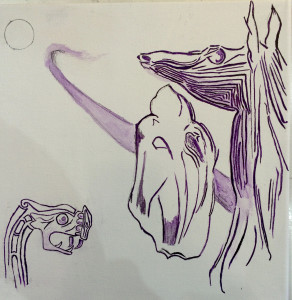
There is a randomness to the way I produce my images. The sources are usually two dimensional. Though I enjoy the discipline of drawing from life, I rarely paint from life. When I taught art I would often draw alongside the pupils, but the only paintings were produced in front of still life arrangements.
Like Francis Bacon, I rely heavily on photographs and drawings from the imagination collected in sketchbooks which I often treat as a journal. The images below are collected as sources for a painting I will be starting soon.
Moody writes with such an understanding of what has been discovered that it is not perceived of as separate from the poet. This intrinsic relationship unites him with Lucy. It is about balance and understanding… as a white male inhabiting the life or space or existence of a female it is his non-threatening position in this, his awakening to Lucy and to so to her experience and life that leads to understanding of her. Moody voices Lucy’s feelings, her thoughts, her exposure, even her ‘rape’. So, in fact, he is sympathetic to her exploitation and her clinical treatment, which disregarded her humanity; while Lucy was helpless in this, Moody gifts her her humanity in his words. She is an object, unable to speak, do or act so is given his voice. There could be reaction against this as Lucy had no choice in this but Moody is aligned with her, not against her and lends her his voice, which otherwise would require her to remain as an object and thus silent.
Andrea Cardow, Associate Tutor (Creativity Culture & Faith), Glasgow University
I still remember, as a precocious, voracious child reading Lucy, the Beginnings of Humankind by Donald C. Johanson and Maitland Armstrong Edey. I was too young to understand much of the science and skipped over the anthropological vocabulary making vague attempts at sounding out language without really absorbing the words. The story, the description, the discovery, what this meant for my understanding of who we were as a species has stayed with me.
I still remember where I was the first time I heard John Moody read from his collection of Lucy Uncatalogued and his masterful use of language which anchors this collection with a reverence for both the literal and metaphorical search for self.
Lucy, the famous Australopithecus afarensis, is the symbolic cornerstone around which the collection orbits. Through Moody’s deep, lyrical exploration of history, memory, and identity, Lucy becomes more than just a prehistoric fossil — she represents the universal search for origins, the complexity of human evolution, and the delicate interplay between our past and present selves. But Moody’s exploration is not just scientific or intellectual. It is spiritual. Lucy is both a figure of awe and a muse that illuminates the soul’s longing for connection, understanding, and truth. This collection is a triumph of poetry that speaks to the heart as much as the intellect. Moody’s exploration of human origins is not only a literal excavation of a species’ past but a profound meditation on our collective search for meaning, an uncovering of the dirt and mess and depth of what it is, has always been, to be human.
Katherine McFarlane award-winning Scottish poet and educator
clouds grey their bellies, white on ropy-smooth torsos; skeins of weather lie across iced-turquoise sky.
Above estuarial water, rest halcyon hills roosting in the mountain’s shadows. Water, edges tucking and then stretching taut under these braes. Watered silk, palest blue, shimmering in tension; waiting for the weather to change and darken the estuary.
As I wait the indeterminate heights gather moisture, sitting saturated on the water’s edge. These clods of earth and stone reflect their bulk imperfectly, stretch the water clamped under basaltic shorelines, as if woven on geologic looms. Hills shrug their moss-green shoulders up to mountains matted with old snow, cloaked in livid clouds, fading to steel grey.
On the estuary’s near shore sit blocky buildings of blond stone, gold in my sight, thrown randomly on the shoreline to catch the gloaming sun.
Two jetties stroke the water, exquisitely drawn in pencil. Graphite shaded precision, no longer launching ships, two lines on satin, taut.
I’m peacefully waiting for night. I wake to dream in a sable tree shadowing the littoral zone.
An arctic blast in early spring from Gaia’s violent play. No moderation does she bring, only gale and gust and fury.
Her breath slows its hasty harass. Silvern frost dusts the swards. Daffodils and crocus mass and bump their flowery heads.
Nature sparkles in her bling, swift to anger. Then she ends her angry fling; becomes serene and tender.
She’s Greek like some chimera inconsistent, often frigid. In Rome we called her Terra. Stern in civic virtue , also rigid.
Complex though seeming inorganic she overwhelms the organismic with climate, which can destroy, violate her play and leave her arid.
We call it weather and it can kill Inconsistent as the woman patriarch’s defame. They call her home—our mother world. Then proceed to slow and sullen matricide.
Printed in Dawntreader Magazine in spring 2019. Published by Indigo Dreams
I have never written about my obsessive interest in prehistoric figurines carved from rock, ivory or sometimes modelled in clay. Does it need to be emphasised? Perhaps as a subject of embarrassment? The interest is obvious if you glance through the library of my visual work.
This will be the final version of this image; the fourth screen-print based on a pencil drawing. The source of the drawings were two separate photographs in a book called From Lucy to Language. Both the print and the original drawing are included, for comparison purposes.
As with many people who paint and draw I also write. Much of this is poetry or prose-poetry. I enjoy trying to construct the complex imagery in a poem, without having to rely heavily on narrative, plot and characterisation.
Most of my work strives for imagery and rythmic use of words, and much of it is very personal in subject matter. Some does address wider subjects, where they catch my interest. Unsurprisingly the recent referendum vote which will change our relationship with the rest of Europe at the behest of a narrow majority of petty English nationalists, peppered with a sprinkling of bigots, caught my attention. I have chosen to express my outrage in what I would describe as a prose poem, mainly because my use of metaphor consisting of the religious customs surrounding bones of venerated individuals mixed with the rituals of an even earlier era when individuals were sacrificed to guarantee their god’s favour for tribe and the expectation of a good harvest. The imagery is consistent with the metaphor. The text only has a very loose narrative and is too short to develop a plot.
These latest screenprints are based on my fascination with the skulls of our remote ancestors. The original drawings were based on photographs of fossilised skulls from our deep past. The drawings were then scanned into a computer and operated into six layers
I learnt screenprinting at art college. This was in the early 1970’s. It it was a graphic process secondary to the photography which I used to document the environments I was working in. The small number of screenprints I produced used some of these 35mm photographic negatives as their source.
The photographs document the obvious stages in my most recent painting. The work is painted in acrylic paint on canavas. The composition was assembled from three different sketchbook drawings. The drawings were copied lightly in pencil and then outlined in an intense violet mixed with a small amount of Prussian Blue. Two thin washes of colour were then applied over the drawing. A cool lemon yellow from the top left corner diagonally to the centre of the canvas.